Legal Challenges in Accidents Involving Autonomous Vehicles in Mississippi
A typical drive on I-55 or a quiet street in Gulfport can become confusing and legally complex in a fraction of a second. Imagine being in a collision, only to discover the person in the other car’s driver’s seat was not actively driving, or perhaps, there was no one there at all. As autonomous and semi-autonomous vehicles become more common on Mississippi roads, these scenarios are moving from theory to reality, creating new and difficult questions for accident victims.
What Are the Levels of Autonomous Driving?
To discuss liability, it is important to first clarify what “self-driving” means. The Society of Automotive Engineers (SAE) defines six levels of driving automation, which are the industry standard. These levels are vital because they help determine who is expected to be in control of the vehicle.
- Level 0: No Driving Automation. The human driver performs all driving tasks. This includes most vehicles on the road today.
- Level 1: Driver Assistance. The vehicle features a single automated system, like adaptive cruise control or lane-keeping assist, but the driver remains in full control.
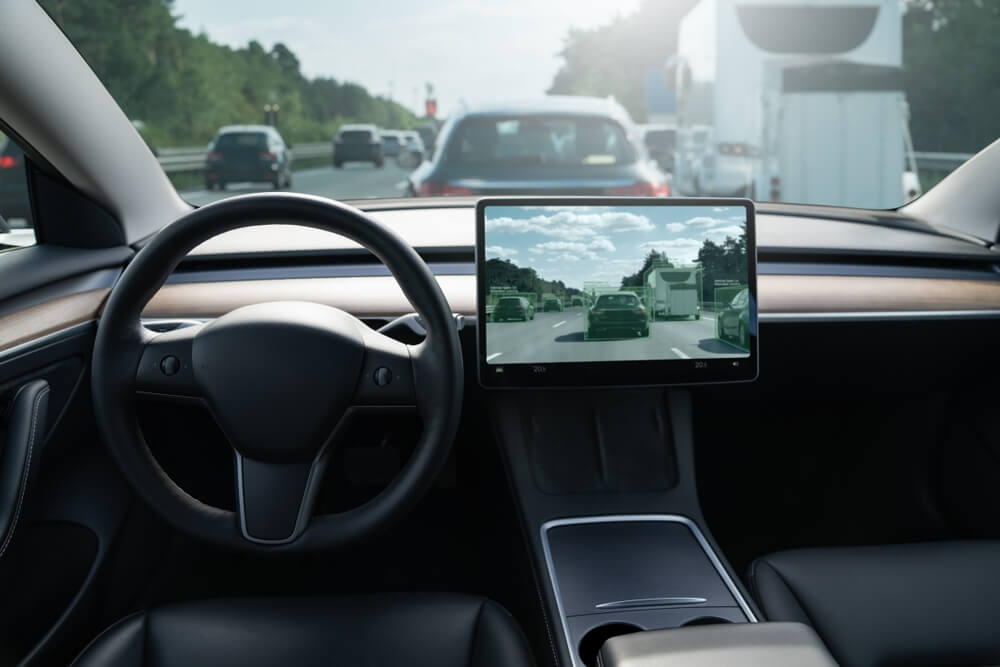
- Level 2: Partial Driving Automation. This is the most common level found in new vehicles, often marketed as “Autopilot” or “Drive Assist.” The vehicle can control steering and acceleration/deceleration simultaneously. However, the human driver must remain fully engaged, monitor the environment, and be ready to take control at any moment.
- Level 3: Conditional Driving Automation. At this level, the car can manage most aspects of driving in certain conditions (like highway traffic). The human driver can be disengaged but must be ready to take over when the system requests.
- Level 4: High Driving Automation. The vehicle can perform all driving tasks and monitor the environment in specific, predefined areas or conditions (a concept known as “geofencing”). It will not require a human to take over in those areas.
- Level 5: Full Driving Automation. The vehicle can perform all driving tasks under all conditions. No human driver is needed.
Most accidents today involve Level 2 systems, where the line between driver responsibility and system capability is thinnest and most contested.
Are Self-Driving Cars Legal in Mississippi?
Mississippi’s laws are still developing in response to this new technology. The state has passed legislation primarily focused on “platooning,” which allows convoys of commercial trucks to operate with automated following technology.
For most passenger vehicles (Levels 1-3), the situation defaults to existing Mississippi traffic and negligence laws. This means that if you are operating a vehicle with Level 2 partial automation, you are still the driver. You are legally responsible for obeying all traffic laws, monitoring the road, and maintaining control of your vehicle. The fact that an automated system was engaged does not, by itself, remove your liability if that vehicle causes a wreck. This lack of specific, comprehensive legislation for personal autonomous vehicles is one of the primary challenges victims face.
Who Is Liable in an Autonomous Vehicle Accident?
This is the central question in any AV accident claim, and the answer is rarely simple. Unlike a standard two-car collision, where you must determine which driver was negligent, an autonomous vehicle crash opens a web of potential defendants. Liability could rest with one or more of the following parties:
- The Human “Driver” or Operator: In Level 2 or Level 3 systems, the human operator is still expected to be attentive and ready to intervene. If they were distracted, asleep, or otherwise failed to take over when the system faltered, they can be held negligent just like any other driver.
- The Vehicle Manufacturer: The automaker (like Tesla, Ford, or GM) could be liable if the accident was caused by a defect in the vehicle’s hardware. This could include faulty sensors, steering components, or braking systems.
- The Software or AI Developer: The company that designed the automated driving system (ADS) could be at fault. If the software’s code was defective, if its AI made a poor decision (like misinterpreting a stopped fire truck or a pedestrian), or if it failed to react to a foreseeable hazard, the developer could be held liable.
- Component Manufacturers: The company that built a specific failed part, like a LIDAR sensor, camera, or radar unit, could also be a party to the claim.
- Other Third Parties: Liability might also extend to a third-party driver who acted erratically, forcing the AV to react, or even a government entity if poorly maintained roads or non-visible lane markings contributed to the system’s failure.
The Battle of Legal Theories: Negligence vs. Product Liability
Because there are so many potentially responsible parties, an AV accident claim often involves two distinct legal concepts simultaneously.
Negligence Claim: This is the standard legal theory used in most car accident cases. To win, you must prove that the defendant (usually the human driver) had a duty to drive safely, breached that duty, and directly caused your injuries and damages. In an AV case, this applies directly to the operator who failed to monitor the system.
Product Liability Claim: This theory is used when a defective product causes harm. In this context, the “product” is the vehicle, its software, or its components. To succeed in a product liability claim, you generally do not have to prove the manufacturer was careless. Instead, you must prove:
- The product had a defect (in its design, manufacturing, or marketing).
- The defect existed when it left the manufacturer’s control.
- The defect was the direct cause of your injury.
Proving a product liability case against a massive auto or tech company requires significant resources, technical knowledge, and a legal team prepared to fight for the evidence needed to show the defect.
What Are Common Causes of Autonomous Vehicle Collisions?
While the technology is designed to be safer than human drivers, it is not infallible. Crashes can and do happen for a variety of reasons.
- Software Malfunction: The system’s AI may misinterpret its surroundings. It might fail to recognize a pedestrian, a cyclist, or a stationary object in the road.
- Sensor Failure: The vehicle’s “eyes”—its cameras, radar, and LIDAR—can be blinded by heavy rain, snow, fog, or even direct sun glare. If a sensor fails or provides bad data, the car’s AI cannot make a safe decision.
- Operator Inattention: This is the most frequent factor in Level 2 crashes. The driver over-trusts the system, becomes complacent, and looks at their phone, watches a movie, or even falls asleep, making them unable to react when the system disengages or fails.
- Unexpected Road Conditions: Faded or missing lane lines, new construction zones, and unusual road debris can confuse the AI, leading it to brake suddenly or swerve.
- Interactions with Human Drivers: Human drivers often act in unpredictable ways (like cutting off another car) that an AV’s programming may not be able to anticipate or react to safely.
What Is the “Black Box” Problem in AV Accidents?
One of the greatest legal challenges in these cases is gaining access to the evidence. Modern vehicles, especially autonomous ones, are equipped with sophisticated Event Data Recorders (EDRs), often called “black boxes.” These devices record a massive amount of data, including:
- The vehicle’s speed and braking.
- Steering wheel inputs.
- Whether the automated system was engaged.
- When the system disengaged or alerted the driver.
- Internal and external camera footage.
- Sensor data from radar and LIDAR.
This data is the single most important piece of evidence. It can prove whether the system failed or the driver was at fault. The problem is that this data is owned and controlled by the manufacturer. Obtaining this data requires swift legal action, often in the form of a spoliation letter or a court order, to prevent the company from deleting or overwriting it.
What Evidence Is Needed for a Self-Driving Car Accident Claim?
Building a strong case requires gathering a wide range of evidence to piece together exactly what happened. A legal team will typically seek:
- The Official Police Report: This provides the initial assessment of the accident, witness information, and any citations issued.
- Event Data Recorder (EDR) Data: As mentioned above, this “black box” data is paramount.
- Vehicle Telemetry Data: Detailed logs from the car’s internal computers.
- Witness Statements: Testimony from other drivers, passengers, or pedestrians who saw the crash.
- Video Footage: This can come from a victim’s dashcam, nearby surveillance cameras, or traffic cameras.
- The Other Driver’s Cell Phone Records: These can be used to prove if a human operator was distracted when they were supposed to be monitoring the vehicle.
- Expert Testimony: These cases often depend on a team of experts, including accident reconstructionists to analyze the physics of the crash and software engineers to analyze the EDR data and identify potential system failures.
What Compensation Can Be Recovered?
A personal injury claim allows you to seek compensation for the full range of losses you have suffered. In Mississippi, these damages are typically categorized in two ways.
Economic Damages: These are your measurable financial losses.
- All medical bills (ambulance, ER, hospital stays, surgery, physical therapy)
- Future medical treatment costs
- Lost wages from time missed at work
- Loss of future earning capacity if you are permanently disabled
- Property damage to your vehicle
Non-Economic Damages: These are for the intangible, but very real, harm you have endured.
- Pain and suffering
- Emotional distress and mental anguish
- Post-Traumatic Stress Disorder (PTSD)
- Loss of enjoyment of life
- Permanent disfigurement or disability
The Future of AV Regulation and Your Rights
The law is currently in a race to catch up with technology. As more advanced (Level 3 and 4) autonomous vehicles are approved, state and federal laws will have to change. New regulations from the National Highway Traffic Safety Administration (NHTSA) will play a large role in setting safety standards and, potentially, in defining liability.
For now, victims are caught in the middle, facing legal battles on multiple fronts. As these cases proceed, they will set important precedents for how Mississippi courts handle these new and challenging claims.
Navigating the Complex Path of an Autonomous Vehicle Claim
If you or a loved one has been injured in a collision involving a self-driving or semi-autonomous vehicle, you are likely facing questions that have few easy answers. You may be dealing with multiple insurance adjusters—one for the driver and another from the manufacturer’s corporate legal department. The legal team at Mississippi Car Accident Attorney is dedicated to helping victims of all types of car accidents. We are closely monitoring the technological and legal developments surrounding autonomous vehicles to protect the rights of the injured. We have the resources and experience to investigate complex collisions, hire the necessary technical experts, and fight to preserve the evidence you need.
Contact us today for a free, no-obligation consultation. Let us listen to what happened, review the details of your case, and explain how we can help you navigate this difficult and uncertain path.


Leave a Reply
Want to join the discussion?Feel free to contribute!